
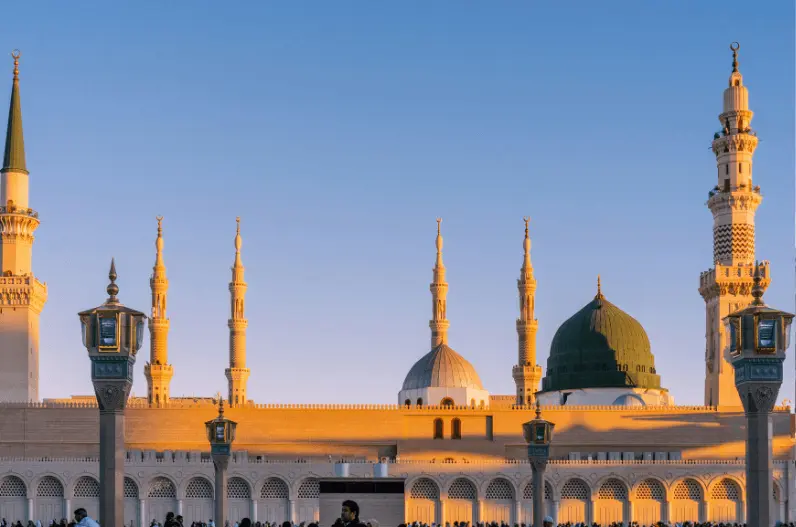
Ziyarat Places in Madinah cover the sacred, historically profound locations connected to the life and sunnah of Prophet Muhammad (PBUH), his noble Sahabah (RA), and the early expansion of Islam in Al-Madinah al-Munawwarah. Key landmarks outside Al-Masjid an-Nabawi include Jannat al-Baqi, Masjid Quba, Mount Uhud & Martyrs’ Cemetery (Shuhada Uhud), Masjid al-Qiblatain, The Seven Mosques (Battle of the Trench), Masjid al-Ghamamah, Masjid al-Jum’ah, Bir Uthman, and traditional Madinah Date Farms. Most outer Ziyarat sites are located between 1.5 km and 8 km from Al-Masjid an-Nabawi, making them easily accessible in a 2 to 3 hour tour. Pilgrims looking for private door-to-door vehicle transfers can book a dedicated Madinah Ziyarat Taxi Service for a comfortable and air-conditioned travel experience.
Madinah Holy Sites Guide — Quick Overview
- Total Key Landmarks: 10 Major Sacred Historical Locations
- Distance Range: 0.5 km to 8 km from Al-Masjid an-Nabawi
- Average Tour Duration: 2 to 3 Hours (Half-Day City Tour)
- Best Visiting Hours: Post-Fajr (6:30 AM – 10:00 AM) or Post-Asr
- Transport Recommendation: Private hotel pickup cab or walking. See our Madinah Ziyarat Taxi Service & Vehicles →
Planning a Ziyarat Tour in Madinah? If you want to hire a private driver and air-conditioned vehicle for your family’s tour of Quba, Uhud, and Qiblatain, visit our service page: Book Madinah Ziyarat Taxi Service →
Understanding Ziyarat in Al-Madinah al-Munawwarah
Visiting Madinah Munawwarah is a deeply emotional and spiritually uplifting journey for every Muslim. Unlike Hajj and Umrah rituals which are localized in Makkah, Ziyarat in Madinah focuses on offering greetings (Salam) to Prophet Muhammad (PBUH) at Al-Masjid an-Nabawi, reflecting upon early Islamic trials at Mount Uhud, and visiting the historic mosques built during the Prophet’s lifetime.
Madinah’s historical landmarks are divided into two main zones:
- Central Haram Zone (Walking Distance): Located immediately within and around Al-Masjid an-Nabawi, including Al-Rawdah ash-Sharifah, Al-Hujrah ash-Sharifah (Sacred Chamber), Jannat al-Baqi Cemetery, Masjid al-Ghamamah, Masjid Abu Bakr, and Masjid Ali. These are visited on foot during daily prayers.
- Outer Madinah Ziyarat Zone (Road Transport Required): Spread across Madinah’s surrounding oases and mountains, including Masjid Quba, Mount Uhud & Shuhada Cemetery, Masjid al-Qiblatain, The Seven Mosques (Battle of Khandaq), Bir Uthman, and Date Gardens. These require a short 2-to-3-hour private tour by car or taxi.
Madinah Ziyarat Distances & Route Overview
The table below provides a quick reference for the major outer Ziyarat locations in Madinah, their distance from Al-Masjid an-Nabawi (Bab al-Salam / King Fahd Gate), typical driving duration, and physical accessibility:
| Ziyarat Location | Distance from Nabawi | Driving Time | Physical Accessibility | Key Historical Significance |
|---|---|---|---|---|
| Masjid Quba | 3.5 km | 8–10 mins | Fully Accessible (Wheelchair Friendly) | First Mosque built in Islam; 2 Rak’ats = 1 Umrah Reward |
| Mount Uhud & Shuhada Uhud | 5.0 km | 10–12 mins | Gentle Walk / Low Archers Hill | Site of Battle of Uhud & Graves of Hazrat Hamzah (RA) & 70 Martyrs |
| Masjid al-Qiblatain | 4.5 km | 10–12 mins | Elevated Steps / Ramp Access | Site where Qibla was changed from Jerusalem to Makkah |
| The Seven Mosques (Khandaq) | 3.0 km | 8–10 mins | Modern Plaza (Easy Walking) | Battlefield of the Trench (5 AH) & Masjid Al-Fath |
| Jannat al-Baqi Cemetery | 0.3 km | Walking Distance | Flat Paved Grounds | Resting place of 10,000+ Sahabah & Prophet’s Family |
| Masjid al-Ghamamah | 0.5 km | Walking Distance | Haram Courtyard Level | Site of Eid prayers & Rain Supplication (Istisqa) |
| Masjid al-Jum’ah | 2.5 km | 6–8 mins | Fully Accessible | Site of the First Friday Prayer led by Prophet (PBUH) |
| Bir Uthman (Ruma Well) | 6.0 km | 12–15 mins | Garden Access | Well purchased by Hazrat Uthman (RA) for public charity |
| Madinah Date Farms (Ajwa) | 7.5 km | 15–18 mins | Flat Orchard Walks | Authentic date palms produces Madinah Ajwa & Safawi dates |
Detailed Guide to Top Ziyarat Places in Madinah
1. Al-Masjid an-Nabawi & Al-Rawdah ash-Sharifah
Al-Masjid an-Nabawi (The Prophet’s Mosque) is the heart of Madinah and the second holiest site in Islam. Established by Prophet Muhammad (PBUH) upon his arrival in 622 CE, the mosque now spans over 400,000 square meters topped by the iconic Green Dome (Al-Qubbah al-Khadra).
- Al-Hujrah ash-Sharifah (Sacred Chamber): Located under the Green Dome lies the room of Hazrat Aisha (RA), where Prophet Muhammad (PBUH) is buried alongside his two closest Caliphs, Hazrat Abu Bakr al-Siddiq (RA) and Hazrat Umar ibn al-Khattab (RA). Pilgrims pass along the golden railing to recite greetings (Assalamu alaika ya Rasool Allah).
- Al-Rawdah ash-Sharifah (Garden of Paradise): Marked by distinctive floral carpets and white pillars, the Rawdah is an area between the Prophet’s house and his Minbar. The Prophet (PBUH) stated: “Between my house and my pulpit is a garden from the gardens of Paradise.” (Sahih Bukhari).
- 2026 Nusuk Permit Rule: Visiting Rawdah ash-Sharifah requires a pre-booked official permit via the Nusuk App. Male and female visitors have separate scheduled time slots throughout the day.
2. Jannat al-Baqi (Al-Baqi Cemetery)
Located directly adjacent to the eastern courtyard of Al-Masjid an-Nabawi lies Jannat al-Baqi (Tree Garden of Baqi), the principal historical cemetery of Madinah.
- Spiritual Significance: Over 10,000 noble Sahabah (companions), wives of the Prophet (Umm al-Mu’minin RA), his daughters (Hazrat Fatima, Ruqayyah, Zainab, and Umm Kulthum RA), his infant son Ibrahim, and the third Caliph Hazrat Uthman ibn Affan (RA) are buried here. Prophet Muhammad (PBUH) frequently visited Baqi at night to pray for those buried within it.
- Visiting Hours & Rules: Male visitors can enter Jannat al-Baqi after Fajr and Asr prayers. Female visitors can pay respect and make supplications from the outer boundary walking paths.
3. Masjid Quba (First Mosque in Islam)
Situated 3.5 km south of Al-Masjid an-Nabawi, Masjid Quba holds the honor of being the very first mosque constructed in Islamic history, founded by Prophet Muhammad (PBUH) during his Hijrah migration in 622 CE.
- Hadith Significance: Prophet Muhammad (PBUH) used to visit Masjid Quba every Saturday (on foot or riding) to offer prayers. He said: “Whoever purifies himself in his house, then comes to Masjid Quba and prays two Rak’ats in it, will have a reward like that of an Umrah.” (Sunan Ibn Majah).
- Quba Avenue Pedestrian Walkway: A beautifully landscaped, illuminated 3 km pedestrian walkway connects Al-Masjid an-Nabawi directly to Masjid Quba, featuring electric carts, cafes, and rest spots.
4. Mount Uhud & Martyrs’ Cemetery (Shuhada Uhud)
Rising 1,077 meters high north of Madinah, Mount Uhud is a massive mountain range spanning 7 km in length.
- Historical Context: In 3 AH (625 CE), the historical Battle of Uhud took place at its base. Seventy noble Sahabah achieved martyrdom during the battle, including the Prophet’s uncle, Hazrat Hamzah ibn Abdul Muttalib (RA), known as Asadullah (The Lion of Allah).
- Key Landmarks:
- Archers’ Hill (Jabal al-Rumat): The small rocky hill where the Prophet (PBUH) positioned 50 archers. Visitors can walk up the hill for a panoramic view of the battlefield.
- Shuhada Uhud Cemetery: The enclosed burial grounds where Hazrat Hamzah (RA), Hazrat Mus’ab ibn Umair (RA), and the 70 martyrs of Uhud rest.
- Prophet’s Affection: Prophet Muhammad (PBUH) expressed deep love for Mount Uhud, declaring: “Uhud is a mountain that loves us and we love it.” (Sahih Bukhari).
5. Masjid al-Qiblatain (Mosque of the Two Qiblas)
Located on a hill northwest of Madinah, Masjid al-Qiblatain is one of the most unique mosques in Islamic history.
- Historical Significance: In 2 AH (624 CE), while Prophet Muhammad (PBUH) was leading the Dhuhr (or Asr) prayer facing Al-Aqsa Mosque in Jerusalem, divine revelation was sent down in Surah Al-Baqarah (2:144): “Turn your face toward al-Masjid al-Haram…” The Prophet immediately turned 180 degrees mid-prayer towards the Kaaba in Makkah, and the congregation followed.
- Modern Facility: The mosque has been expanded into a stunning twin-minaret structure with landscaped gardens, plaza levels, and parking.
6. The Seven Mosques (Sab’u Masajid) & Battle of Khandaq
Located at the western base of Mount Sela lies the historic battlefield of the Battle of the Trench (Ghazwat al-Khandaq) fought in 5 AH (627 CE).
- Historical Context: Upon the advice of Hazrat Salman al-Farsi (RA), Muslims dug a deep trench along the open northern border of Madinah to defend the city against an army of 10,000 confederates.
- The Mosques: The site originally contained six small historical mosques where key Sahabah maintained defensive outposts: Masjid Al-Fath (where the Prophet prayed for 3 days for victory), Masjid Salman al-Farsi, Masjid Abu Bakr, Masjid Umar, Masjid Ali, and Masjid Fatima. A large modern central mosque now serves visitors alongside the preserved historical structures.
7. Masjid al-Ghamamah & Courtyard Mosques
Located roughly 500 meters southwest of Al-Masjid an-Nabawi in the central plaza:
- Masjid al-Ghamamah (Mosque of the Cloud): Situated on the spot where Prophet Muhammad (PBUH) performed Eid prayers and offered Salat al-Istisqa (prayer for rain). During the rain prayer, a cloud shaded the Prophet from the intense sun before heavy rain fell over Madinah.
- Masjid Abu Bakr & Masjid Ali: Located adjacent to Ghamamah, marking the sites where Caliph Abu Bakr (RA) and Caliph Ali (RA) led Eid prayers during their respective caliphates.
8. Masjid al-Jum’ah & Masjid al-Ijabah
- Masjid al-Jum’ah: Located near Quba, this mosque marks the exact location where Prophet Muhammad (PBUH) led the first historical Friday congregational prayer (Jum’ah) after leaving Quba for central Madinah.
- Masjid al-Ijabah (Mosque of Supplication): Located 380 meters north of Jannat al-Baqi, this mosque is where the Prophet (PBUH) offered three long supplications for his Umrah—two of which were granted by Allah, as recorded in Sahih Muslim.
9. Historic Wells of Madinah (Bir Uthman & Bir Ghars)
Madinah’s ancient wells played a vital role in early Islamic history:
- Bir Uthman (Well of Ruma): When Muslim migrants faced water scarcity in Madinah, Hazrat Uthman ibn Affan (RA) purchased this well from a Jewish trader for 20,000 dirhams and dedicated it as a free perpetual endowment (Waqf) for all citizens. It remains an active Waqf project producing date palms to this day.
- Bir Ghars: Located near Quba, this well’s sweet spring water was loved by Prophet Muhammad (PBUH), who requested that water from Bir Ghars be used for his ghusl.
10. Madinah Date Farms & Ajwa Orchards
Surrounding Madinah are historic date palm oases that produce the world’s most celebrated dates.
- Ajwa Dates of Madinah: Prophet Muhammad (PBUH) stated: “Whoever has seven Ajwa dates every morning will not be harmed on that day by poison or magic.” (Sahih Bukhari).
- Visiting Date Farms: Ziyarat tours often include a stop at an authentic date farm where pilgrims can sample fresh Ajwa, Safawi, and Anbara dates directly from local farmers.
How to Plan Transport for Madinah Ziyarat
Choosing your transport mode depends on your schedule, comfort preferences, and group size:
- Private Taxi Tour (Recommended): Provides direct hotel lobby pickup, personalized driver waiting times at Quba, Uhud, and Qiblatain, individual air conditioning, and zero stress for elderly family members. Visit our dedicated Madinah Ziyarat Taxi Service page for fleet choices.
- Quba Pedestrian Walkway: A scenic 3 km paved walk from Al-Masjid an-Nabawi to Masjid Quba, suitable for young travelers during cool morning hours.
- Group Tour Buses: Operate fixed multi-passenger routes with limited time stops at major landmarks.
Practical Ziyarat Tips for Madinah Visitors
- Book Rawdah Permits Early on Nusuk: Ensure you book your Rawdah ash-Sharifah slot on the Nusuk App weeks before your arrival in Madinah.
- Perform Wudu Before Visiting Masjid Quba: Perform ablution (Wudu) at your hotel room before heading to Masjid Quba to gain the reward equivalent to an Umrah.
- Schedule Ziyarat During Off-Peak Hours: Start your outer Ziyarat tour right after Fajr prayer (between 6:30 AM and 9:30 AM) to complete your visits before midday heat.
- Respect Etiquette at Shuhada Uhud & Baqi: Maintain quiet reverence when making Dua for the martyrs of Uhud and Sahabah at Jannat al-Baqi. Avoid climbing onto graves or unapproved rituals.
- Pre-book Private Vehicles: For seamless hotel pickup, pre-arrange a fixed-rate private cab on our Madinah Ziyarat Taxi Service page.